


Search isn’t what it used to be. Not even close. You’ve seen it yourself: people are asking ChatGPT the same questions they used to ask search engines. They’re seeing Google’s AI overview before any search result pops up.
A few years ago, showing up on Google meant ranking in a list of blue links. Your goal was page one, position one. That’s still important, but it’s no longer the whole picture. As a marketing agency with years of experience in SEO, we know that the way people find information, discover businesses, and make decisions has fundamentally shifted, and AI is driving that shift faster than almost anyone anticipated.
Today, a potential customer might ask ChatGPT for the best plastic surgeon in Athens, GA. They might use Google’s AI Mode to research landscape services before they ever click a link. They might see your business mentioned in an AI Overview before they’ve scrolled to a single organic result. Or they might ask Gemini for a recommendation and get your name, your address, and your phone number before your website link even appears. This is GEO, or generative engine optimization, and it’s permanently shifting the world of SEO.
But how do you make sure your business shows up in this new era of search?
This post breaks down exactly how AI and large language models are changing SEO, what each surface means for your visibility, and what it looks like in practice for real businesses we’ve worked with.
Part 1: LLMs and Your Business
What Are LLMs and Why Do They Matter for SEO?
LLMs, or large language models, are the AI systems powering tools like ChatGPT, Gemini, Claude, and Perplexity. They’re trained on enormous amounts of data from across the internet, which means they’ve read your website, your reviews, your Google Business Profile, and every mention of your business they could find. When someone asks one of these tools a question, they generate a response based on everything they’ve learned, and that response often includes specific business recommendations. But how do they decide what information to pull? Google uses Retrieval-augmented generation (RAG), which relies on its existing Search rankings, to ensure it’s pulling relevant data from up-to-date websites to generate its responses.
TL: DR? Your search rankings still heavily impact whether LLMs will use your information or not.
Hear it from Google themselves– “From Google Search’s perspective, optimizing for generative AI search is optimizing for the search experience, and thus still SEO.”
This is a new kind of search behavior, and it’s growing fast. Generative AI reached 53% population adoption within three years, faster than the personal computer or the internet. Four in five university students now use generative AI. Your customers are already using these tools. The question is whether your business shows up when they do. At MORE creative agency, we believe in an integrated SEO & GEO approach. To show up where it matters in 2026, you can’t have one without the other, which is why we offer SEO and GEO services together.
Mentions vs. Citations
When it comes to AI visibility, not all appearances are created equal. A mention from an AI is when a large language model like ChatGPT, Gemini, or Perplexity refers to your business by name in a generated response, often as a recommendation in natural language, without necessarily linking to your site.

A citation is more formal: the AI explicitly attributes information to your website as a source, typically with a linked reference visible to the user.

Mentions tend to happen in conversational AI interactions where someone asks for a recommendation, and your business gets named in the answer. Citations happen when an AI tool like Google’s AI Overview pulls directly from your content to support a specific claim or answer, and it’s not always an answer directly about your business. For example, if your service page for gate installation includes information about the most common styles of gates, an LLM may respond to someone searching “what are the most popular styles of gates to install in residential builds” with a citation from your page. It won’t mention your company by name, but the information’s source (your website) will be included. Both mentions and citations signal that your business has earned credibility in the eyes of AI systems, and a strong GEO strategy builds the kind of authority that earns both.
The Avenue Aesthetics Example
We searched “breast revisions in Athens, GA” across ChatGPT, Claude, and Gemini. All three returned our SEO client, Avenue Aesthetic and Reconstructive Surgery, first, ahead of every competitor in the market. But how each LLM displayed that result was different.


ChatGPT included a map with Avenue’s address. Claude provided a direct overview of the practice with a phone number and a prompt to visit the website. Gemini led with general information about breast revision surgery (sourced from the Avenue website) before listing Avenue as the top local option. Three different AI tools. Three different formats. One consistent result: Avenue Aesthetics was the most trusted source in the market, and every LLM agreed.
That doesn’t happen by chance. It’s the result of years of SEO work that built Avenue’s credibility, keyword rankings, and content depth to the point where AI tools across the board treat them as the authoritative answer for plastic surgery in Athens. Avenue saw a 207% increase in keyword rankings and a 367% increase in organic traffic through MORE’s SEO strategy, and that foundation is exactly what earns LLM mentions and citations at this level.
The same signals that drive traditional search rankings also drive LLM visibility. Page credibility, content quality, clear business information, consistent reviews, and technical SEO all contribute to whether AI tools trust your business enough to name it first.

Part 2: Five Other Ways AI Is Influencing Search Right Now
Beyond chatbots, Google’s own search experience has been transformed by AI. Here are the five placements that matter most for local businesses right now.
1. AI Overview Recommendations
AI Overviews appear at the very top of Google search results, above the traditional organic links. They’re generated by Google’s AI and pull information directly from websites, Google Business Profiles (GBP), and other sources to create a summary answer. For local searches, they often include business recommendations with names, addresses, contact information, and a direct link to schedule or inquire.
Getting featured in an AI Overview is a direct result of having your information clearly and accurately presented on your website and GBP, having the page credibility and ranking strength that signals trustworthiness to Google’s AI, and publishing content that directly addresses the questions people are searching for.

Avenue Aesthetics appears consistently in AI Overviews for plastic surgery searches in the Athens area. When someone searches for a procedure and Google’s AI generates a summary, Avenue’s practice information, location, and services are pulled in as the primary recommendation. That visibility is a direct result of their SEO foundation and the work MORE has done to ensure every piece of information Google looks for is clearly labeled and easy to find.
2. GEO Citations
We’ve discussed how Generative Engine Optimization is the practice of optimizing your content and online presence so that AI tools cite your business as a source in generated answers. A GEO citation is when an AI tool explicitly links back to your website as the source for a specific piece of information. This happens both within LLMs and in Google Search itself.
What earns citations is:
- Content that answers specific questions clearly
- Structured data that helps AI systems read and understand your pages
- Consistent credibility signals across the web
- Enough topical depth that AI tools consider you an authoritative source worth referencing
Sound familiar? The same things that improve your normal SEO rankings are the things that encourage AI tools to cite your work. They go hand in hand.

Select Fencing is a great example of what targeted content strategy does for AI citation visibility. When we started working with them, their keyword rankings for core fencing terms in Athens were scattered across pages 3 through 5 in Google. Through location pages targeted for specific service areas, blog content built around the questions customers actually search for, technical SEO fixes, and FAQ sections structured to answer queries the way AI tools expect, their rankings moved dramatically. For “Fence Installation” in Athens, they went from rank 42 to rank 4, “Wood Fencing” went from rank 22 to rank 1, “Steel Fencing” went from rank 21 to rank 1, and Select is consistently mentioned in AI Overviews for every single one of these search queries. When AI tools look for a fencing company in Athens, they find a website built to be cited.
3. AI Mode
AI Mode is Google’s dedicated AI search experience, where the entire results page is AI-generated rather than a traditional list of links. It’s more conversational and detailed than a standard AI Overview, and it’s powered by Gemini. Google upgraded AI Mode with Gemini 3.5 Flash as the new default model globally at Google I/O 2026, making it faster and more capable than ever.
In AI Mode, Google pulls from websites that have demonstrated credibility over time. If your page rankings are strong, your content is well-structured, and your business information is clear and consistent, AI Mode will surface you confidently for searches related to your services and locations.
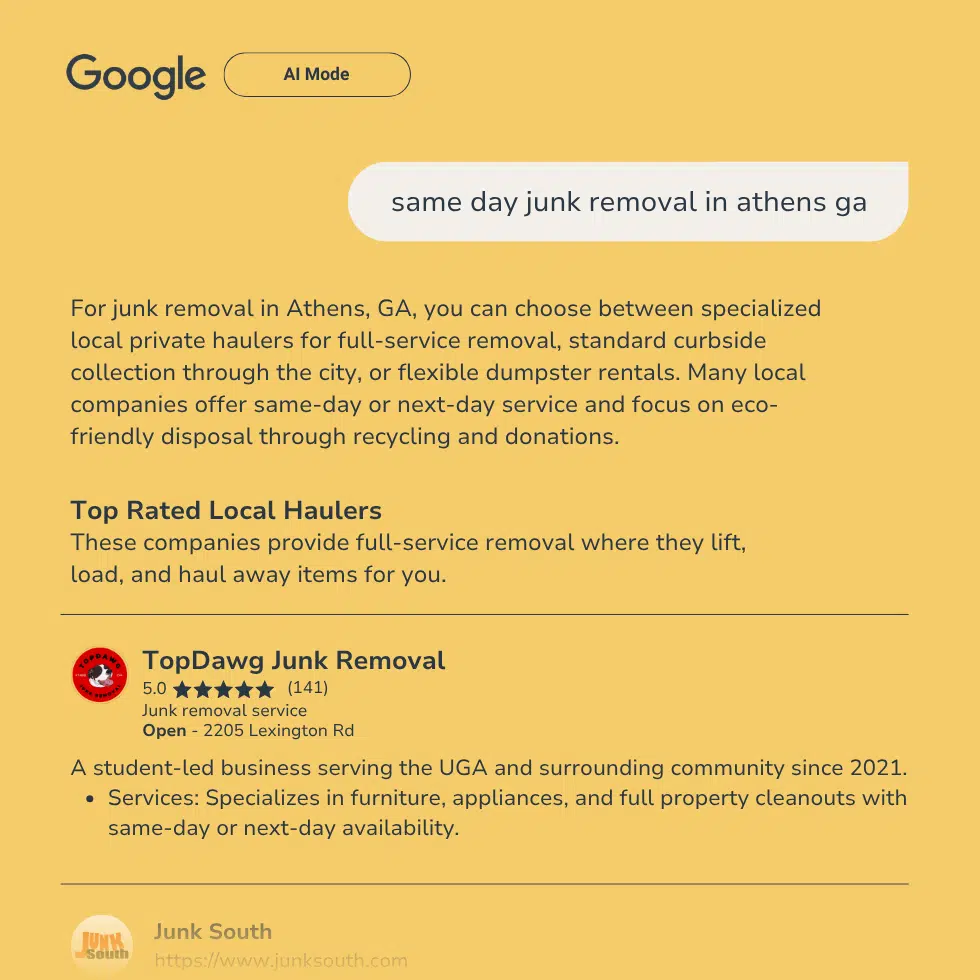
TopDawg Junk Removal had excellent page rankings and a strong content foundation because of our SEO work with them before AI Mode even became a major factor. That head start mattered. When Google’s AI Mode began pulling local service recommendations, TopDawg was already the kind of business its system trusted: strong keyword rankings, targeted location pages covering dozens of cities and service areas, and content structured specifically around the queries their customers search for. Today, when someone uses AI Mode to search for junk removal services in Athens or across their service area, TopDawg shows up. That’s what credibility built over time looks like in an AI search world.
4. Google Knowledge Panel
The Knowledge Panel appears on the right side of Google search results when someone searches your business name directly. It pulls information about your business, including your address, hours, phone number, website, photos, and reviews, and it’s increasingly powered by AI to surface the most relevant details to the person searching.
What feeds a Knowledge Panel is primarily your Google Business Profile, your structured data and schema markup, and how consistently your information appears across the web. A complete, accurate, and regularly updated GBP is one of the most direct ways to control what appears there.

We prioritized creating a well-maintained and fully updated Google Business Profile for our SEO client Doors By Mike, which means that when someone searches for them directly, or when AI tools pull information for a recommendation, the data is accurate, current, and complete. Their hours are right. Their services are listed. Their photos are updated. Their reviews are active. AI often pulls directly from GBP when citing or mentioning a local business in generated answers, which means having an incomplete or outdated profile is effectively leaving your AI visibility up to chance.
Part 3: What You Can Do Right Now
So what does all of this mean for your business? Here’s where to focus:
- Make sure your Google Business Profile is complete, accurate, and regularly updated. This is one of the highest-leverage things you can do for both traditional and AI search visibility.
- Build content that directly answers the questions your customers are searching for. FAQ sections, location-specific pages, and educational posts all perform well in AI-generated answers.
- Prioritize page credibility: site speed, mobile performance, clear structure, and consistent internal linking all contribute to whether AI tools trust your site as a source.
- Earn reviews consistently. AI tools factor review presence and recency into how they evaluate local business credibility.
- Make sure your business information is consistent everywhere it appears online. Conflicting details across directories and platforms create confusion for AI systems and reduce how confidently they’ll reference you.
If you want to understand how your current SEO and GEO foundation maps to AI search readiness, or if you’re looking to build a strategy that earns both traditional rankings and AI citations, let’s talk. With over five years of experience in SEO, MORE creative agency can build you the perfect integrated SEO and GEO strategy to get your business in front of the right audience.
Curious About What’s Coming Next?
AI search is accelerating, not slowing down. Here are a few recent events worth knowing about if you want to stay ahead of where things are heading.
Google I/O 2026 (May 19-20, 2026): Google introduced an AI-powered search box that generates contextual answers, images, and short videos, making it more assistant-like in function. The event emphasized Google’s shift toward agentic AI, where systems don’t just answer questions but actively assist with tasks. Search as we’ve known it is being rebuilt from the ground up around AI. Read the full recap.
Stanford AI Index Report 2026: Organizational AI adoption reached 88%, and generative AI reached 53% of the population faster than either the PC or the internet. The 2026 report confirms capability is accelerating, not plateauing. The businesses that treat AI as a present reality rather than a future trend are the ones building advantages right now. Read the full report.